Single Tooth Implant Turkey: Steps, Healing Time and Trips to Istanbul
Missing one tooth and planning treatment in Istanbul? A single tooth implant in Turkey replaces that tooth from the root up, without grinding down the healthy teeth on either side.
This guide covers candidacy, each visit, healing time, immediate placement, front teeth, and when a bridge may suit you better. The Dental Implants in Turkey team, based in Beyoğlu a short walk from Taksim Square, can give you a first opinion from the X-ray you already have.
Last updated: 5 November 2026
Quick answer: what is a single tooth implant in Turkey, and who is it for?
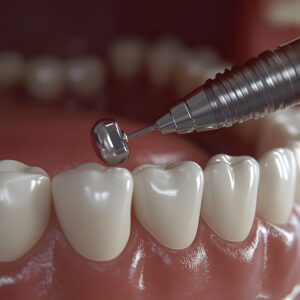
A single tooth implant in Turkey is a small titanium or zirconia post placed in the jawbone where one tooth is missing, topped with an abutment and a custom crown once the bone has fused to it; it usually suits healthy adults with enough bone, healthy gums and good daily oral hygiene.
Most patients need two trips to Istanbul: one to place the implant and one to fit the final crown. Between them, the bone bonds to the implant over roughly three to nine months, according to Cleveland Clinic, while you are back home.
Important medical note
This article is general education, not a diagnosis. Only an examination and 3D imaging can confirm suitability, timing and grafting needs. Always tell your dentist if you have diabetes, take osteoporosis medication or blood thinners, smoke or vape, or have had radiotherapy to the head and neck.
Who is a good candidate for a single tooth implant?
A good candidate for a single tooth implant is an adult in good general health, with enough jawbone to hold the implant, gums free of active disease, and the habit of cleaning their teeth every day. Cleveland Clinic notes the usual minimum age is 18, once the jaws have finished growing, and there is no upper age limit.
The ADA's MouthHealthy site adds that overall health matters more than age, and that diabetes and tobacco can slow healing.
Usually ready
Healthy adult, enough bone on the scan, healthy gums, and any long-term conditions well controlled.
Needs preparation first
Active gum disease, untreated decay or a thin ridge. These are treated or rebuilt before the implant goes in.
Needs careful assessment
Uncontrolled diabetes, certain bone or autoimmune conditions, and smoking or vaping.
Diabetes alone does not rule you out; read our guide to dental implants for diabetic patients. If you smoke, Dr. Abdurrahman Ozturk's article on smoking and dental implants explains why quitting before surgery helps.
A gap left untreated can let teeth drift and bone shrink; see the consequences of losing one tooth.
Single implant vs bridge: which is better for one missing tooth?
When the neighbouring teeth are healthy and the bone is adequate, a single implant is usually the more tooth-friendly option, because it replaces the missing tooth on its own; a bridge hangs a false tooth from crowns on the teeth beside the gap.
The American Academy of Periodontology (AAP) explains that a bridge requires the adjacent healthy teeth to be reshaped, while a single implant leaves them untouched. Because the implant replaces the root, it also helps keep the jawbone intact, whereas the bone under a bridge tends to break down over time. Cleveland Clinic calls that enamel removal irreversible.
| Factor | Single tooth implant | Traditional three-unit bridge |
|---|---|---|
| Neighbouring teeth | Left untouched | Reshaped and crowned to hold the bridge |
| Jawbone | Acts like a root and helps preserve bone | Bone under the false tooth may shrink over time |
| Daily cleaning | Brush and floss like a natural tooth | Floss threaders or interdental brushes under the bridge |
| Total timeline | Several months, because of bone healing | Usually two visits; lab work takes about 2–4 weeks |
| Surgery | Yes, under local anaesthetic | No |
| Often best for | Healthy neighbours and enough bone | Neighbours that already need crowns, or patients who cannot have surgery |
If the teeth beside the gap already need crowns, a bridge can treat them and close the space at once. For more, see dental implants vs dental bridges.
Not sure if a single tooth implant suits you?
Send your panoramic X-ray or CBCT scan on WhatsApp. Our team will share a first opinion on your options and how many trips to plan.
Ask for a first opinion on WhatsAppHow does a single tooth implant work, step by step?
A single tooth implant in Istanbul follows six main steps: consultation, CBCT scan, implant placement, osseointegration, abutment and final crown. Mayo Clinic describes a similar sequence, adding extraction of the damaged tooth and bone preparation when needed.
- Remote consultation: send your X-ray and medical history on WhatsApp for a draft plan.
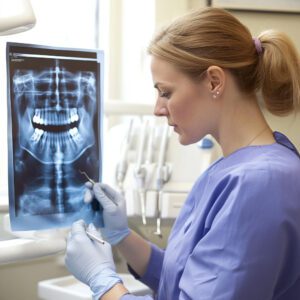
- Examination and CBCT scan: gums and bite are checked and a 3D scan measures the bone.
- Implant placement: under local anaesthetic, with a cover or healing cap.
- Osseointegration: the bone bonds to the implant over months while you are at home.
- Abutment: a small connector is attached and the gum heals around it.
- Final crown: a digital impression, then a shade-matched crown is fitted.
Consultation and CBCT scan
CBCT (cone-beam computed tomography) is a dental scan that rotates around the head to create a 3D image of the teeth and jaws. The US Food and Drug Administration (FDA) lists implant planning among its main uses. It shows bone height and width and the position of the nerve and sinus.
Its dose is generally lower than other CT exams but higher than standard dental X-rays, the FDA notes. Our sister clinic explains AI-assisted dental implants in Istanbul; software never replaces clinical judgement. See also how 3D guided implant surgery turns a scan into a precise surgical plan.
Placement day
Placement is an outpatient procedure under local anaesthetic; most patients feel pressure rather than pain. Mayo Clinic lists gum and facial swelling, bruising, pain at the site and minor bleeding as expected after surgery. See is dental implant surgery painful?
If the bone is too thin or soft, grafting may come first. Mayo Clinic notes a graft can take several months to become strong enough for an implant, although minor grafting can sometimes be done during implant surgery. Learn more in our dental bone graft guide.
How long does a single tooth implant take from start to crown?
A single tooth implant usually takes several months from start to crown, because the bone needs about three to nine months to fuse with the implant, according to Cleveland Clinic. In practice, that means two trips to Istanbul with healing time at home in between.
Osseointegration is the process in which living bone bonds directly to the implant surface until it is as stable as a natural root. Its length depends on bone quality, implant position, grafting and your healing.
Mild swelling, bruising and minor bleeding; pain relief is prescribed.
Swelling settles and the gum starts to close. Cleveland Clinic says initial healing takes about a week.
Bone starts bonding; avoid hard chewing on that side.
Osseointegration completes and is checked by X-ray.
The abutment is placed. Mayo Clinic notes the gum needs at least two weeks to heal around it before the crown is attached, unless the abutment was placed with the implant.
How many trips to Istanbul do you need for one implant?
Most patients need two trips to Istanbul for one implant: a first stay of about 3–5 days for the scan and placement, and a second stay of about 4–7 days for the abutment and crown, several months later. These are planning estimates, not promises; your final schedule is set after the examination.
| Stage | What happens | Typical stay in Istanbul |
|---|---|---|
| Trip 1 | Examination, CBCT scan, treatment plan, implant placement (plus extraction or grafting if needed), first check-up | About 3–5 days for most patients |
| Healing at home | Osseointegration, WhatsApp follow-up, optional check with your local dentist | Usually 3–6 months, sometimes longer |
| Trip 2 | Check X-ray, abutment, digital impression, crown try-in and fitting | About 4–7 days for most patients |
The schedule can grow if you need a bone graft or a sinus lift.
Immediate vs delayed implant: what is the difference?
An immediate implant is placed in the same appointment as the extraction, while a delayed implant is placed after the socket has healed for weeks or months. Both are valid; the right choice depends on the bone, the gum and whether there is infection.
Immediate placement normally requires no acute infection, good primary stability of the implant in the bone and an intact bone wall, especially for front teeth. A 2021 review in Case Reports in Dentistry calls primary stability the most important factor for fitting an immediate temporary tooth, and links gum recession to a thin gum type, a damaged facial bone wall and an implant placed too far forward.
An immediate implant saves a surgery but does not shorten osseointegration. Otherwise, healing the socket first is safer. If a tooth is removed during your trip, follow our tooth extraction aftercare guide.
Front tooth implant: how do you get a natural look?
A front tooth implant needs more careful aesthetic planning than a back tooth, because the bone on the lip side is usually thin and a small error in angle or depth can show in the gum line when you smile.
- Crown-first planning: the implant's angle and depth are chosen from the ideal position of the final crown, not the other way round.
- Tissue support: a small bone or gum graft may be advised.
- A temporary tooth: Cleveland Clinic notes that a temporary tooth can be made for front implants so you do not have a visible gap while healing.
- Colour matching: the crown's shade and translucency are matched to your neighbouring teeth, often in zirconia or E-max.
Watch: missing teeth, from single implants to All-on-6
Missing teeth solutions: from single implants to All-on-6
In this short reel, our clinic team walks through options for missing teeth, from a single implant to full-arch All-on-6. The number of missing teeth and the bone decide the right solution. One missing tooth is usually replaced with one implant and one crown, leaving the neighbouring teeth alone.
How do you care for a single tooth implant?
You care for a single tooth implant much like a natural tooth: brush twice a day, clean between your teeth daily and keep regular dental check-ups. Long-term success depends heavily on these habits.
- Brush twice daily and floss or use an interdental brush around the implant.
- Eat soft foods after each surgical stage, as Mayo Clinic advises, and avoid hard chewing on that side early on.
- Stop smoking, or at least cut down, during healing.
For a full routine, read our guide to maintaining your dental implants.
Warning signs: contact your dentist promptly if you notice
- Bleeding that does not stop with firm pressure on gauze.
- Swelling or pain that gets worse after the second or third day instead of easing.
- Fever, pus, or swollen gums or neck glands.
- A loose or wobbly implant or crown.
- Numbness in the lip or chin that lasts after the anaesthetic wears off.
Cleveland Clinic lists a loose implant, bleeding or swollen gums, fever, pus and swollen lymph nodes as reasons to call your dentist. Mayo Clinic explains that if the bone does not fuse well, the implant is removed and the procedure can be tried again in about three months.
How does remote follow-up work once you are home?
Remote follow-up works through WhatsApp: you send photos and symptoms, and your local dentist can take an X-ray for our team to review.
Your second visit is set by your actual healing, not a fixed date. Learn how online dental consultations work in teledentistry and online dental consultation.
Why plan your single tooth implant in Turkey with Dental Implants in Turkey?
At Dental Implants in Turkey, we first ask whether your own tooth can be saved, and recommend an implant only when it genuinely suits you. Treatment plans are overseen by Dr. Abdurrahman Ozturk and his team in Beyoğlu.
Clinic location: Gümüşsuyu Mah., Mete Cad., Beyoğlu, Istanbul — a few minutes' walk from Taksim Square.
Digital planning
CBCT and intraoral scanning to place the implant where the ideal crown needs to sit.
Honest comparison
Implant, bridge and other options explained with their pros and limits.
Clear communication
Questions answered in English on WhatsApp, from the first assessment to the final crown and beyond.
Taksim Clinics' guide to choosing the best dental implant clinic in Turkey lists the criteria worth checking.
Key takeaways on a single tooth implant in Turkey
- A single implant replaces one tooth from the root without reshaping the neighbouring teeth.
- A CBCT scan shows how much bone you have and whether grafting is needed.
- Osseointegration usually takes three to nine months.
- Most patients need two trips to Istanbul of a few days each.
- Immediate implants suit selected cases; front teeth need especially careful planning.
- A bridge makes sense when the neighbouring teeth already need crowns.
Related articles
Dental implants in Turkey 2026: the complete guide How many days do dental implants take in Turkey? When dental implants cannot be placed Signs that a dental implant is failing How long does a dental implant last? Zirconia bridge vs E-max crowns Types of dental implants used in TurkeyPlan your implant before you fly to Istanbul
Send your X-ray or a short description of your case on WhatsApp. We will tell you whether a single implant looks suitable and how many trips to plan. The final plan is made after your examination at our Beyoğlu clinic.
WhatsApp: +90 534 445 94 44 Visit our websiteSingle tooth implant Turkey: frequently asked questions
How long does a single tooth implant take in Turkey from start to crown?
Usually several months, because the bone needs about three to nine months to fuse with the implant, according to Cleveland Clinic. Most patients need two trips: one for the implant, one for the crown.
How many days do I need in Istanbul for one implant?
The first trip usually takes about 3–5 days and the second about 4–7 days. Extraction or grafting can change this; the final plan follows your examination.
Is a single tooth implant painful?
It is done under local anaesthetic, and most patients feel pressure rather than pain. Swelling and mild soreness in the first days are usually managed with prescribed pain relief.
Which is better for one missing tooth: an implant or a bridge?
With healthy neighbouring teeth and enough bone, an implant usually protects those teeth and the jawbone better. If the neighbours already need crowns, or surgery is unsuitable, a bridge can be sensible.
Can a front tooth implant be placed on the same day as the extraction?
In selected cases, yes: with no acute infection, good primary stability and an intact bone wall. A temporary tooth can sometimes be fitted, but bone healing still takes months.
Will I have a gap while the implant heals?
Not necessarily. For front teeth, a temporary tooth can usually be made for the healing period.
Do I need a bone graft before a single tooth implant?
Not always. A CBCT scan shows your bone. A small shortfall may be grafted during implant surgery; a larger one can need several months of healing first.
How does follow-up work after I return home?
On WhatsApp: you send photos and symptoms, and your local dentist can take an X-ray for our team to review before your second trip.
Conclusion: is a single tooth implant in Turkey right for you?
A single tooth implant in Turkey replaces a missing tooth from the root while leaving the neighbouring teeth untouched, but it is not a decision to make without an examination. The scan and examination decide bone, timing and whether a bridge fits better. With good planning, two trips to Istanbul and remote follow-up in between are usually enough.
Still deciding? Send your images to our Beyoğlu team for a clear, realistic plan.
Medical sources
- Cleveland Clinic. Dental Implants. my.clevelandclinic.org
- Cleveland Clinic. Dental Bridges. my.clevelandclinic.org
- Mayo Clinic. Dental implant surgery. mayoclinic.org
- American Academy of Periodontology (AAP). Single Tooth Dental Implants. perio.org
- American Dental Association – MouthHealthy. Dental Implants. mouthhealthy.org
- U.S. Food and Drug Administration (FDA). Dental Cone-beam Computed Tomography. fda.gov
- Meng HW, Chien EY, Chien HH. Immediate Implant Placement and Provisionalization in the Esthetic Zone: A 6.5-Year Follow-Up and Literature Review. Case Reports in Dentistry, 2021. pmc.ncbi.nlm.nih.gov