Gum Graft Around Dental Implant: Types, Timing and Healing in Istanbul
Has the gum shrunk back around your implant, does the area look grey, or does brushing it hurt? A gum graft around a dental implant (soft tissue grafting) can thicken the gum and add a firm band of protective tissue, so the implant is easier to clean and looks more natural.
This guide covers when a graft is needed, FGG vs CTG vs collagen matrices, timing, healing and aftercare. The Dental Implants in Turkey team works in Beyoğlu, near Taksim Square, Istanbul.
Last updated: 27 November 2026
Quick answer: what is a gum graft around a dental implant?
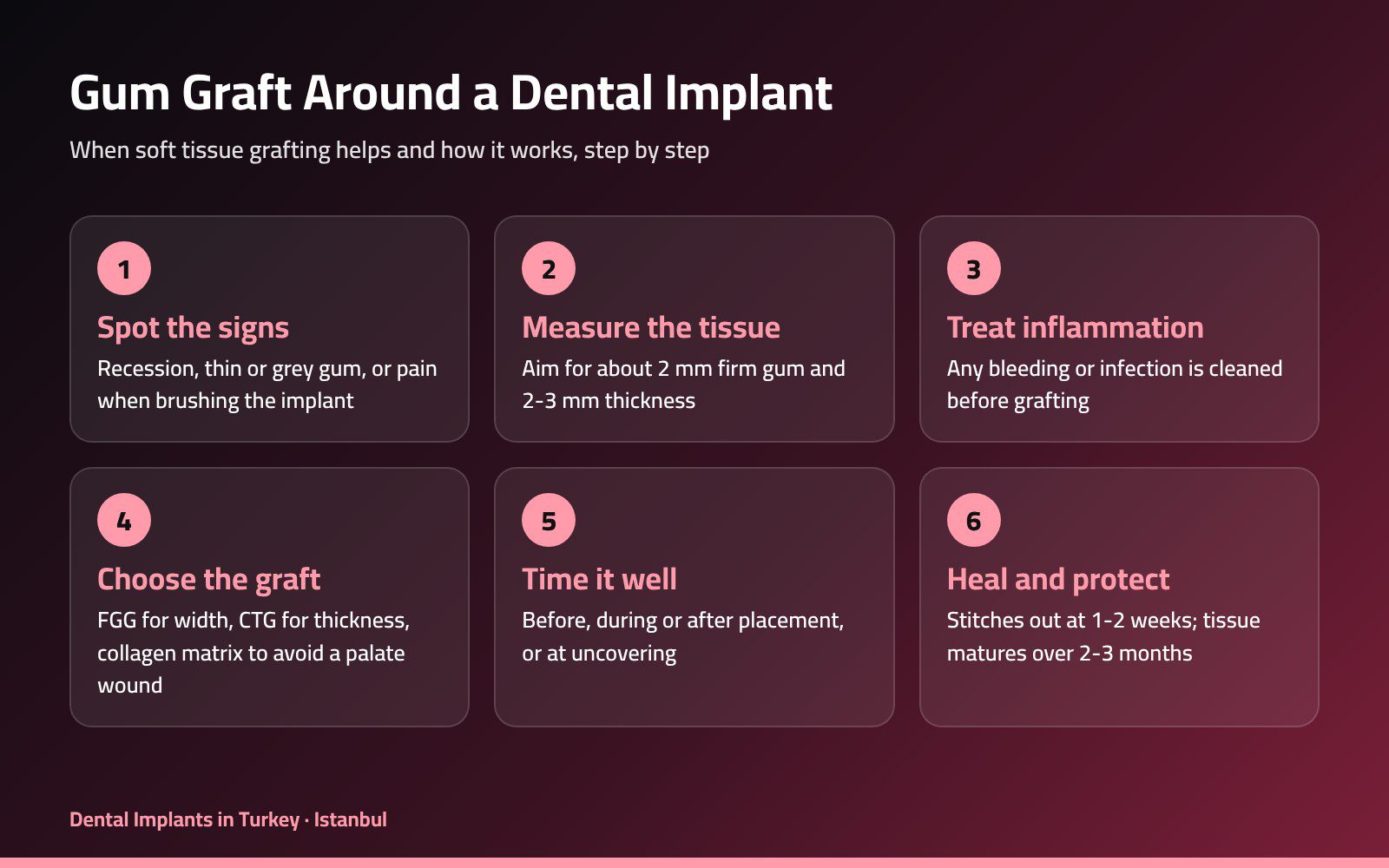
A gum graft around a dental implant is minor surgery that adds soft tissue where the gum is too thin or lacks firm keratinized mucosa. Research links at least 2 mm of keratinized mucosa and roughly 2–3 mm of tissue thickness with less plaque, less brushing discomfort, more stable bone and better aesthetics.
The tissue comes from your palate (free gingival or connective tissue graft) or a collagen matrix such as Mucoderm or Mucograft, placed before, during or after the implant.
Important medical note
This article is general education, not a diagnosis. Recession or pain around an implant can also signal infection (peri-implantitis), which must be treated before any graft.
What is a soft tissue graft for dental implants?
A soft tissue graft for dental implants adds gum tissue around an implant to widen firm, keratinized mucosa or thicken the gum. It does not rebuild bone; that is the job of a dental bone graft.
Keratinized mucosa is the firm, pale-pink, attached gum that does not move when you pull your lip. The peri-implant soft tissue phenotype, as Tavelli and colleagues described it in 2021, includes three measures: keratinized mucosa width, mucosal thickness and supracrestal tissue height.
Width
Firm keratinized mucosa around the implant; 2 mm is the usual reference.
Thickness
Gum over the bone and implant; 2 mm or less is usually called thin.
Height
Vertical soft tissue above the bone.
Why do keratinized mucosa width and gum thickness matter around implants?
They matter because implants lack the fibre attachment natural teeth have. A firm, thick collar of gum resists brushing trauma and inflammation and hides the metal of the implant.
At least 2 mm of keratinized mucosa
A four-year study by Perussolo and colleagues followed 202 implants in 54 patients. Sites with less than 2 mm of keratinized mucosa had more plaque, more bleeding, about three times higher brushing-discomfort scores and more marginal bone loss (0.26 mm vs 0.06 mm) than sites with 2 mm or more.
About 2–3 mm of tissue thickness
In a 2009 clinical trial of 46 implants, Linkevicius and colleagues found that when gum thickness was 2.0 mm or less, crestal bone loss of up to 1.45 mm could occur in the first year.
Thickness also controls colour. In a laboratory study by Jung and colleagues, titanium caused the most discolouration, while through 3.0 mm of mucosa no colour change was visible with any material.
A balanced view: the 2017 World Workshop consensus called the evidence on keratinized mucosa and long-term implant health equivocal, but agreed it may make plaque removal easier and brushing more comfortable. Grafting is a case-by-case decision.
What are the signs you may need a gum graft around an implant?
You may need a gum graft around an implant if the gum is receding, the tissue looks thin or grey, brushing the area hurts, or the gum around the implant moves when you pull your lip or cheek. A dentist confirms this by measuring width and thickness.
- Recession at the implant: the crown looks longer or metal appears at the gum line.
- Thin tissue: the implant outline shows through the gum.
- Grey show-through: a grey shadow above the crown, often in front teeth.
- Pain when brushing: soreness makes you avoid cleaning the implant.
- Mobile gum: the tissue moves when you pull your lip or cheek.
Our sister clinic explains dental implant metal showing through the gum. For a dark edge at a crown on a natural tooth, see the black line between gum and crown.
Which techniques are used: FGG, CTG or a collagen matrix?
The three main techniques are the free gingival graft (FGG), the connective tissue graft (CTG) and collagen matrices such as Mucoderm and Mucograft. FGG best increases keratinized width, CTG best increases thickness and aesthetics, and matrices avoid a second wound in the palate.
Free gingival graft (FGG)
A free gingival graft is a thin strip of surface tissue taken from the palate and stitched beside the implant to create a new band of firm, keratinized mucosa. In the 2021 network meta-analysis by Tavelli and colleagues (52 articles, 23 randomized trials), FGG with an apically positioned flap was the most effective way to gain keratinized width. Its colour can stay paler than the neighbouring gum, so it is used more often in back areas.
Connective tissue graft (CTG)
A connective tissue graft is tissue taken from under the palate surface and placed beneath a flap to thicken the gum. The colour blends well, so CTG is often preferred in the smile zone. The same review found CTG gave the highest gain in mucosal thickness and supported marginal bone stability.
Collagen matrices (Mucoderm, Mucograft)
Collagen matrices are processed, sterile collagen membranes that act as a scaffold for your own gum cells. Mucograft is a porcine collagen matrix, and Mucoderm is a porcine-derived acellular dermal matrix. In a randomized trial of 20 patients by Sanz and colleagues, a collagen matrix produced 2.5 mm of keratinized tissue at six months, versus 2.6 mm for a connective tissue graft, with less pain and shorter surgery.
How do FGG, CTG and collagen matrices compare?
FGG, CTG and collagen matrices differ mainly in what they add, where the tissue comes from and how comfortable healing is. Your surgeon chooses based on the site and the goal.
| Feature | Free gingival graft (FGG) | Connective tissue graft (CTG) | Collagen matrix (Mucoderm / Mucograft) |
|---|---|---|---|
| Main goal | Wider keratinized mucosa | Thicker gum, better aesthetics | Width or thickness, depending on the product and technique |
| Source | Surface of your palate | Under the surface of your palate | Processed collagen; no palate wound |
| Evidence highlight | Most effective for width gain with an apically positioned flap (Tavelli 2021) | Highest thickness gain; bone stability benefit (Tavelli 2021) | 2.5 mm vs 2.6 mm width at 6 months vs CTG (Sanz 2009) |
| Colour match | Can look paler | Usually blends well | Usually blends well |
| Shrinkage | Some contraction expected | Generally stable volume | Contraction can be marked (about 60–67% in Sanz 2009, both groups) |
| Often chosen for | Back teeth, mobile tissue, painful brushing | Front teeth, grey show-through, thin tissue | Patients who want to avoid a palate harvest, smaller defects |
The Thoma 2018 systematic review (2,823 records screened) found that grafts of your own tissue gave significantly less marginal bone loss when thickness was increased.
Thin or receding gum around your implant?
Send a close-up photo of the implant area and any recent X-ray on WhatsApp. Our team will share a first opinion on whether a soft tissue graft, cleaning or another step makes more sense.
Ask about a gum graft on WhatsAppWhen is the best time for soft tissue grafting: before, during or after the implant?
Soft tissue grafting can be done before implant placement, at the same surgery, at uncovering (second-stage surgery) or after the crown is fitted. Grafting earlier, before the final crown, usually gives more predictable results than repairing recession later.
If a bone graft or sinus lift is also needed, the order matters. See our sinus lift surgery guide and the sister clinic's page on sinus lift surgery in Turkey.
What does the healing timeline look like?
Most gum grafts around implants heal in a similar pattern: swelling for a few days, stitches out at one to two weeks, surface healing within a few weeks and tissue maturing over about two to three months.
For a graft-only visit, many patients plan about a week in Istanbul (an indicative estimate); the stitch removal can then be done at a return visit or by your local dentist. See how many days you need for dental implants in Turkey if grafting is part of a full implant plan.
How should you care for a soft tissue graft?
You care for a soft tissue graft by protecting it from pressure and movement for the first two weeks, keeping the rest of your mouth clean, and following the rinse and medication plan your surgeon gives you.
- Do not brush or floss the graft itself until told; clean other teeth normally.
- Rinse gently with the prescribed mouthrinse.
- Eat soft, cool food for the first days and chew on the other side.
- Do not pull your lip to look at the graft; this can move it.
- Avoid smoking and vaping, which reduce blood flow to the graft.
Worried about pain? Read is dental implant surgery painful? Long-term, our guide to maintaining your dental implants covers daily habits.
What are the risks and warning signs after a gum graft?
The main risks of a gum graft around an implant are pain and bleeding from the palate, swelling, partial graft shrinkage or loss, colour mismatch and, less often, infection. Most problems are minor when caught early.
Warning signs: contact your clinic promptly if you notice
- Bleeding from the palate that does not stop after 20–30 minutes of firm pressure with gauze.
- Swelling or pain that gets worse after day three instead of better.
- Fever, pus or a bad taste from the graft area.
- The graft turning white and loose, or moving away from its place.
- A loose implant crown or new pain when biting.
Pain or pus around an implant can mean infection; read signs that a dental implant is failing.
Watch: dental implant treatment in Istanbul, step by step
In this one-minute video, Dr. Abdurrahman Öztürk explains implant treatment in Istanbul: 3D CBCT scan, placement, healing and the final crown. A soft tissue graft, when needed, usually fits in at placement or uncovering.
Why have a gum graft around your implant in Istanbul with Dental Implants in Turkey?
At Dental Implants in Turkey, we first find out why the gum is thin or receding and treat any inflammation, then recommend the graft and timing. Plans are overseen by Dr. Abdurrahman Öztürk in Beyoğlu, Istanbul.
Measured first
Width, thickness and bone level checked before any graft.
Choice explained
FGG, CTG or a matrix, with honest limits.
Timed with your implant
Combined with placement or uncovering where possible.
Our sister practices also cover this topic: see gum recession causes and treatment at Taksim Clinics and periodontal surgery and gum grafting in Istanbul at AI Dent Clinic. For the wider picture, read dental implants in Turkey.
Dental Implants in Turkey · Gümüşsuyu Mah., Mete Cad., Beyoğlu, Istanbul (near Taksim Square) · Phone / WhatsApp: +90 534 445 94 44 · Hours: Mon–Fri 08:00–19:00, Sat 08:00–15:00.
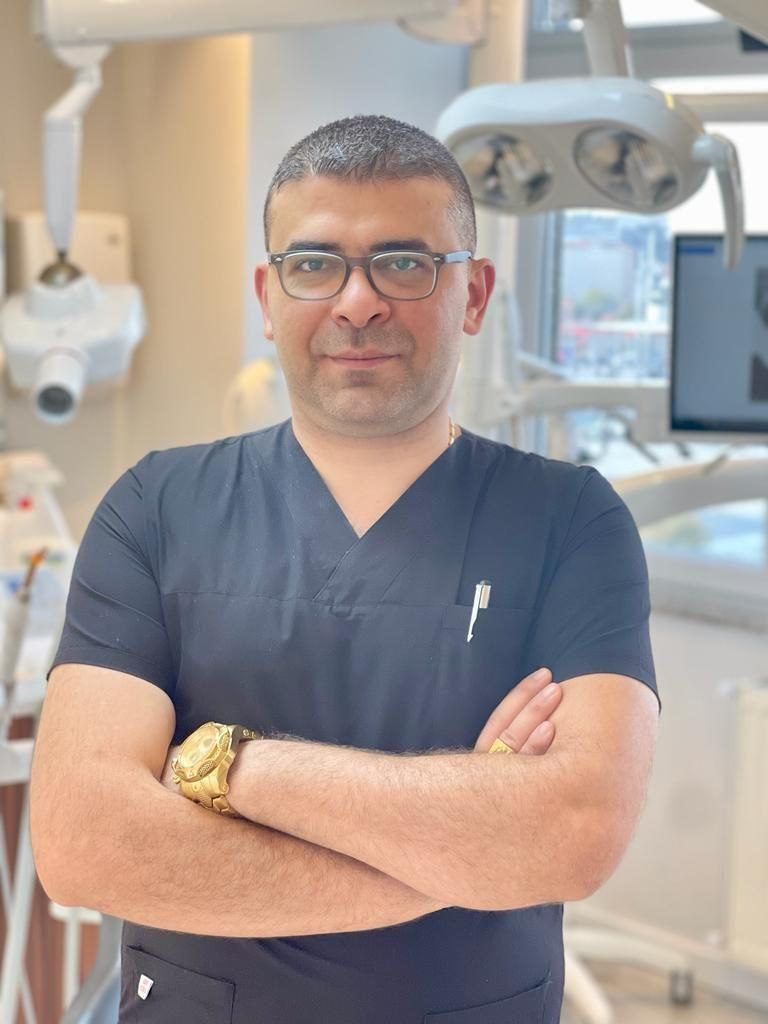
Medically reviewed by Dr. Abdurrahman Öztürk
Dentist and clinic medical lead in Beyoğlu, Istanbul, with more than 15 years of experience. He reviewed this guide on 27 November 2026.
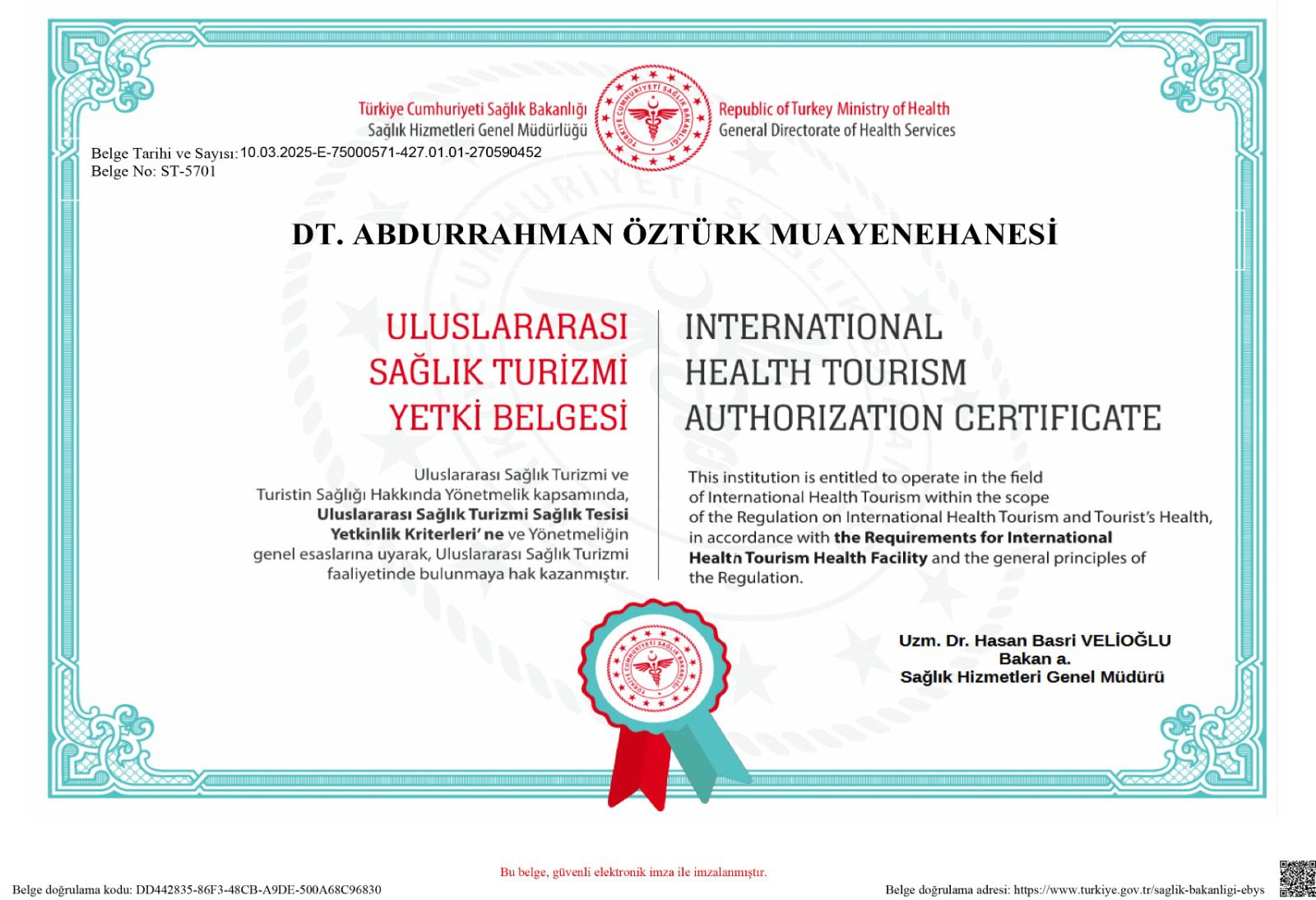
Dt. Abdurrahman Öztürk Muayenehanesi holds the Republic of Türkiye Ministry of Health International Health Tourism Authorization Certificate No. ST-5701 (issued 10.03.2025): view certificate · verify on turkiye.gov.tr (verification code DD442835-86F3-48CB-A9DE-500A68C96830).
Key takeaways on gum grafts around dental implants
- A gum graft adds soft tissue, not bone.
- Studies link less than 2 mm of keratinized mucosa with more plaque, inflammation, recession and brushing discomfort.
- Gum 2 mm thick or less was linked with up to 1.45 mm of first-year bone loss; at 3 mm no metal colour showed through in a lab study.
- FGG is strongest for width, CTG for thickness and aesthetics, and collagen matrices avoid a palate wound.
- Grafting before the final crown is usually more predictable than repairing recession later.
Related articles
Dental bone graft: when and why it is needed Single tooth implant in Turkey How long do dental implants last? What happens if you delay gum disease treatment Can dental implants fail? Implant aftercare and maintenance (AI Dent Clinic) Bleeding gums: causes and treatmentsGum graft around dental implant: frequently asked questions
Do all dental implants need a gum graft?
No. Many implants have enough firm, thick gum. A graft is considered when keratinized mucosa is under about 2 mm, the gum is thin, recession appears or brushing hurts.
How much keratinized gum should an implant have?
Studies commonly use 2 mm as the reference. A four-year study of 202 implants found sites with less than 2 mm had more plaque, bleeding, brushing discomfort and bone loss.
Can a gum graft fix grey gum around an implant?
Often it can improve it. Thickening the gum with a connective tissue graft or matrix masks metal better; in a lab study, no colour change was visible through 3 mm of mucosa.
Which is better around implants, FGG or CTG?
It depends on the goal. FGG is the most effective for widening firm keratinized tissue; CTG gives the most thickness and a better colour match, so it is often used in front teeth.
Can a collagen matrix replace tissue from my palate?
Sometimes. In one randomized trial, a collagen matrix gave 2.5 mm of keratinized tissue versus 2.6 mm with a connective tissue graft, with less pain.
Is a gum graft around an implant painful?
The procedure is done under local anaesthetic. Afterwards, soreness is usually greatest in the palate donor site for the first few days and is managed with prescribed pain relief.
How long does a gum graft take to heal?
Stitches usually come out at about 7–14 days, the surface heals within a few weeks, and the tissue matures over roughly two to three months before final restorative steps.
Can I have a gum graft for my implant in Istanbul?
Yes. Dental Implants in Turkey plans soft tissue grafting in Beyoğlu, near Taksim. Send photos and X-rays on WhatsApp at +90 534 445 94 44 for a first opinion.
Plan your implant gum treatment before you fly
Send close-up photos of your implant, your X-rays and a short note about what you notice. We will tell you whether a gum graft looks suitable and how many days to plan in Istanbul.
WhatsApp: +90 534 445 94 44 Visit our websiteMedical sources
- Perussolo J, et al. Influence of the keratinized mucosa on peri-implant tissue stability and brushing discomfort: 4-year follow-up. Clin Oral Implants Res, 2018. PubMed 30346630
- Linkevicius T, et al. The influence of soft tissue thickness on crestal bone changes around implants. Int J Oral Maxillofac Implants, 2009. PubMed 19885413
- Jung RE, et al. In vitro color changes of soft tissues caused by restorative materials. Int J Periodontics Restorative Dent, 2007. PubMed 17694948
- Thoma DS, et al. Effects of soft tissue augmentation procedures on peri-implant health or disease. Clin Oral Implants Res, 2018. PubMed 29498129
- Tavelli L, et al. Peri-implant soft tissue phenotype modification and its impact on peri-implant health: network meta-analysis. J Periodontol, 2021. PubMed 32710810
- Sanz M, et al. Clinical evaluation of a new collagen matrix (Mucograft prototype) to enhance the width of keratinized tissue. J Clin Periodontol, 2009. PubMed 19678861
- Berglundh T, et al. Peri-implant diseases and conditions: consensus report of workgroup 4, 2017 World Workshop. J Periodontol, 2018. PubMed 29926955