How Is Jawbone Grafting Done? Steps, Types, and Healing Time Before Dental Implants
When the jawbone loses part of its volume, width, or height, there may not be enough bone to place a dental implant in the ideal position. In these situations, the dentist or oral surgeon may recommend a dental bone graft, a group of procedures designed to increase, preserve, or rebuild bone volume before dental implant treatment when needed. The exact bone graft procedure varies from one case to another. It may be a simple graft placed after tooth extraction, Guided Bone Regeneration (GBR), a sinus lift, or a more extensive reconstruction of the alveolar ridge.
What Is a Jawbone Graft in Simple Terms?
A jawbone graft is a surgical procedure designed to increase the amount, width, or density of bone in an area where bone has been lost.
Bone or a bone substitute material is placed in the deficient area to create a scaffold that supports the body's natural formation of new bone.
The procedure is commonly used before dental implant placement when the existing bone is not sufficient to surround and support an implant properly.
Important Medical Note
Not every dental implant patient needs a bone graft. The need for bone grafting cannot be determined by looking at the gum alone. The dentist must assess bone width, height, shape, the planned implant position, the condition of the teeth and gums, and in many cases a three-dimensional CBCT scan may be recommended when detailed evaluation of the bone and nearby anatomical structures is required.
Why Do Some Patients Need a Bone Graft Before Dental Implants?
Dental implants require an adequate amount of jawbone to provide stability and allow the implant to be positioned in a way that properly supports the final crown, bridge, or prosthesis.
After a tooth is lost, the surrounding bone may gradually shrink over time, particularly if the area remains without a tooth for a long period.
Bone loss can also result from advanced gum disease, infection, trauma, previous extractions, or anatomical limitations.
When bone width or height becomes insufficient, placing the implant in the ideal position may be difficult without rebuilding the area first.
Long-Term Tooth Loss
Gradual bone resorption may occur after a tooth is lost, causing the ridge that previously supported the root to become narrower.
Periodontal Disease
Advanced periodontal disease may result in loss of the bone that supports and surrounds the teeth.
Naturally Thin Bone
Some patients naturally have limited bone thickness, particularly in certain areas of the front of the jaw.
Where Does the Bone Used for Jaw Grafting Come From?
The term “bone graft” does not always mean that a piece of bone must be taken directly from the patient's body.
Several types of grafting materials are available. The dentist selects the material according to the size of the defect, its location, the surgical technique, and the overall treatment plan.
| Type of Graft | Source | Main Principle |
|---|---|---|
| Autograft | The patient's own body | Bone can be collected from another area of the mouth or from another donor site depending on the size of the reconstruction. |
| Allograft | Human donor tissue from an approved tissue bank | The material is processed and prepared to act as a scaffold supporting new bone formation. |
| Xenograft | Processed animal-derived material | Frequently used in bone augmentation procedures as a scaffold that supports bone regeneration. |
| Alloplast | Synthetic materials | Artificial bone substitutes may include materials based on calcium phosphate or hydroxyapatite. |
How Is Jawbone Grafting Done Step by Step?
The exact details depend on the procedure, but the general sequence in many bone grafting surgeries is as follows:
1. Examination and Bone Assessment
The dentist begins by examining the teeth and gums and identifying the area of bone deficiency. When planning dental implants, the amount of bone required around the implant and the position of the final tooth are considered.
2. Imaging and Treatment Planning
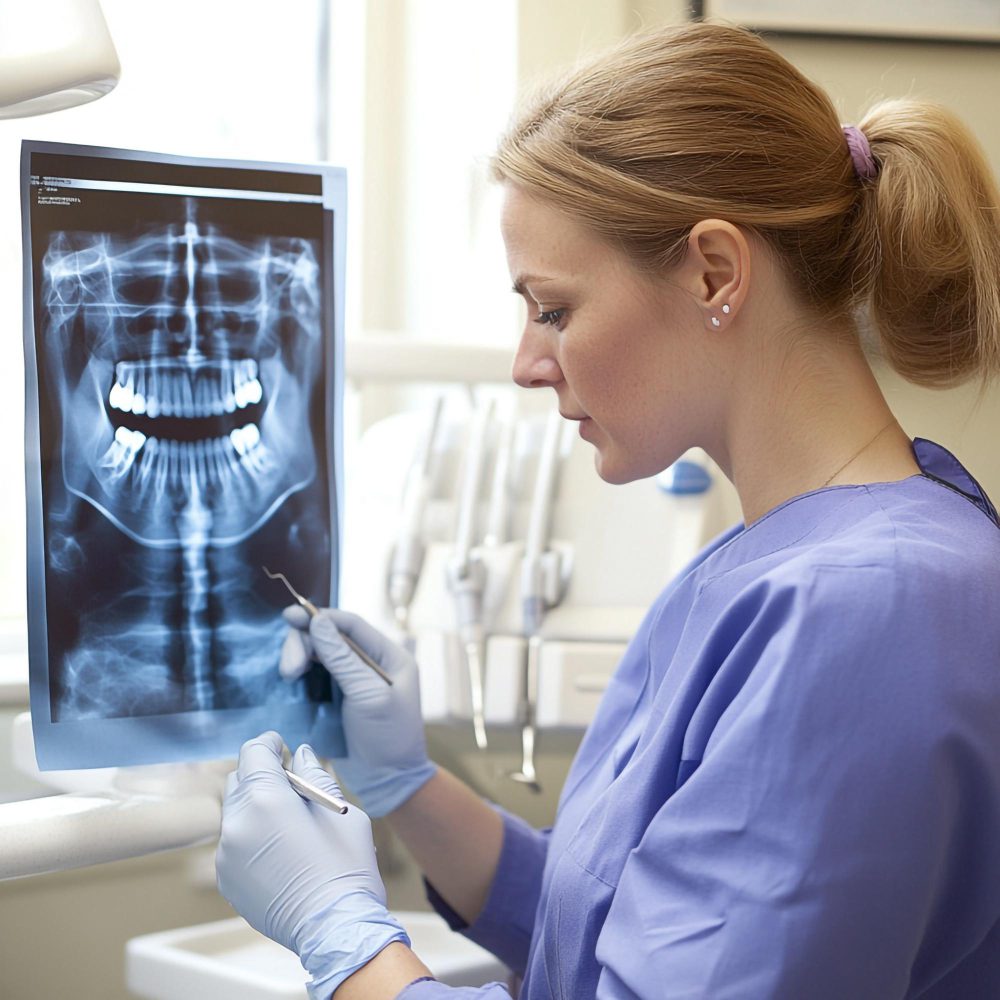
Conventional X-rays may be used, and in cases requiring three-dimensional information, a CBCT scan may be requested. This helps assess bone width, bone height, and the relationship of the planned surgical site to important anatomical structures such as the maxillary sinus or the nerve canal in the lower jaw.
3. Anesthesia
Many bone grafting procedures are performed under local anesthesia. For larger procedures or patients requiring additional sedation, other options may be considered by the medical team depending on the type of surgery and the patient's health.
4. Opening the Gum
The surgeon makes a small incision in the gum to access the area of bone that requires reconstruction.
5. Cleaning and Preparing the Graft Site
Unsuitable tissue is removed and the bone surface is prepared according to the technique being used. If infection is present or a tooth needs to be removed, the area is treated appropriately.
6. Placing the Bone Graft Material
The graft material is placed in the planned location and in the required volume. The aim is not simply to fill a space, but to create the appropriate bone shape and volume for the future restorative and implant treatment.
7. Placing a Barrier Membrane When Needed
In Guided Bone Regeneration (GBR), a barrier membrane may be placed over the graft material. The membrane helps separate the regenerating bone area from the faster-growing soft tissues during healing.
8. Closing the Surgical Site With Sutures
The gum is repositioned over the graft and the area is closed with sutures. The healing and monitoring phase then begins.
9. Waiting for Bone Maturation
The surface soft tissue usually heals before the bone underneath. New bone formation and maturation require more time. After the appropriate healing period, the dentist reassesses the area before moving to the next stage of treatment.
What Is Guided Bone Regeneration (GBR)?
Guided Bone Regeneration (GBR) is a technique used to increase bone volume in areas with localized bone deficiency.
The technique commonly involves placing bone graft material and covering it with a barrier membrane.
The membrane separates the grafted area from rapidly growing soft tissue and helps create an environment in which bone cells can rebuild the deficient area.
GBR is used in many localized defects around dental implant sites. In some cases, implant placement and GBR can be performed at the same time, while in other cases bone must be rebuilt first and the implant is placed only after healing.
What Is the Difference Between a Minor Bone Graft and a Major Bone Graft?
| Situation | Type of Deficiency | Possible Treatment Plan |
|---|---|---|
| Socket Preservation | Immediately after tooth extraction | Graft material may be placed in the extraction socket to help preserve the volume of the area. |
| Small Defect Around an Implant | Localized bone deficiency | Bone augmentation may sometimes be performed at the same time as implant placement in selected cases. |
| Insufficient Jaw Width | The alveolar ridge is narrower than required | GBR or another horizontal bone augmentation technique may be considered. |
| Severe Bone Loss | Significant loss of bone volume | A separate bone grafting procedure may be required, followed by healing before implant placement. |
| Insufficient Bone Below the Maxillary Sinus | Limited bone height in the posterior upper jaw | A sinus lift may be considered, with or without additional grafting. |
Can a Bone Graft and Dental Implant Be Done at the Same Time?
Yes. In selected cases, a dental implant and bone graft can be performed during the same surgical appointment.
This is more likely when the dentist can achieve adequate primary stability for the implant and the bone defect can be reconstructed around it.
If the bone loss is extensive and there is not enough existing bone to stabilize the implant in the correct position, it may be preferable to rebuild the bone first, allow it to heal, and place the implant at a later stage.
How Long Does a Jawbone Graft Take to Heal?
It is important to distinguish between initial soft-tissue healing and bone graft maturation.
The gum tissue may feel considerably better within the first days and weeks, but the grafted bone usually needs several months to reach a stage suitable for implant assessment.
Smaller grafts may mature within several months, while larger reconstruction procedures can require longer healing periods, sometimes as long as 9 to 12 months depending on the individual case.
There is therefore no single healing period that applies to every patient.
| Stage | What Usually Happens |
|---|---|
| First Few Days | Mild to moderate swelling or discomfort may occur as the soft tissues begin healing. |
| First to Second Week | Swelling and discomfort usually begin to improve gradually in most patients. |
| First Few Months | The graft material continues to integrate while new bone develops in the area. |
| After Several Months | The dentist may reassess the site to determine whether it is ready for dental implant placement. |
When Can a Dental Implant Be Placed After a Bone Graft?
The timing depends on the size of the graft, the surgical technique, the location, and the condition of the existing bone.
In some cases, the implant is placed at the same time as the graft. In other cases, the dentist may wait approximately three months or longer, while larger reconstruction procedures may require a significantly longer healing period.
The decision should not be based on a fixed number of months alone. What matters is whether the area has matured sufficiently and whether adequate implant stability can be achieved.
Is Jawbone Grafting Painful?
During the procedure, the patient should not feel surgical pain in the properly anesthetized area.
After the anesthesia wears off, some discomfort, swelling, or tenderness may occur. The degree of discomfort depends on the size of the procedure, the location of the graft, and the surgical technique used.
In many limited grafting procedures, postoperative discomfort can usually be managed with the medication and aftercare instructions provided by the dentist.
Is Facial Swelling Normal After Bone Grafting?
A degree of swelling after surgery can be expected, especially during the first few days.
Mild bruising or sensitivity around the surgical area may also occur.
However, swelling that continues to increase instead of improving, severe worsening pain, pus or discharge, fever, or other unusual symptoms should be reported to the dentist or surgeon.
What Are the Signs of Successful Bone Grafting?
The success of a bone graft cannot be judged by the appearance of the gum alone.
The real objective is the formation of sufficient bone with the quality and volume required for the planned implant treatment.
Evaluation may include:
- Healing of the surgical site without obvious infection.
- Stable soft tissues.
- No persistent abnormal pain or swelling.
- Maintenance of the required bone volume.
- Appropriate new bone formation on clinical and radiographic evaluation.
- The ability to place the implant in the planned position with adequate stability.
Can a Bone Graft Fail?
Yes. Like any surgical procedure, bone grafting cannot be guaranteed to succeed in 100% of cases.
Possible complications can include infection, exposure of the membrane or graft material, partial loss of graft volume, insufficient bone formation, or failure to obtain the desired bone dimensions.
However, partial graft loss does not necessarily mean that the entire procedure has failed. The severity of the problem varies, and the appropriate next step should be determined after examination.
What Can Cause a Jawbone Graft to Fail?
Several factors may contribute, and the exact cause usually cannot be determined without examining the patient and surgical site.
- Infection at the surgical site.
- Early exposure of the graft or membrane.
- Poor soft-tissue healing.
- Excessive movement in the grafted area.
- Smoking.
- Poor postoperative wound care.
- Certain uncontrolled health conditions.
- A large or complex bone defect.
- Insufficient soft tissue to cover the grafted site.
Can Patients With Diabetes Have a Bone Graft?
Having diabetes does not automatically mean that a patient cannot have bone grafting or dental implants.
However, blood sugar control, general health, medications, and the potential for delayed healing must be carefully evaluated before surgery.
Patients with poorly controlled diabetes may need better medical stabilization before some elective surgical procedures are performed.
How Does Smoking Affect Jawbone Grafting?
Smoking is an important risk factor that should be discussed before bone grafting and dental implant surgery.
Smoking can negatively affect blood supply and soft-tissue healing and is associated with an increased risk of certain complications after oral surgery and implant treatment.
Patients should inform the dentist about all forms of smoking, vaping, and nicotine use before treatment planning.
Does Bone Graft Material Dissolve?
Bone graft materials differ in how quickly they are resorbed and replaced.
Some materials act as a temporary scaffold that is gradually replaced by new bone formed by the patient's body, while other graft materials may remain in the area for a longer period.
For this reason, small remnants of graft material may remain visible within the new bone depending on the type of material used and the amount of time that has passed since surgery.
Is It Normal for Small Bone Graft Particles to Come Out?
Some patients may notice a few small particles that feel like grains of sand during the first days after certain particulate bone graft procedures.
The loss of a small number of particles does not automatically mean that the graft has failed.
However, losing a large amount of graft material, wound opening, increasing pain, or discharge requires contacting the treating dentist.
What Should I Do After Jawbone Grafting?
- Follow your dentist's instructions carefully.
- Avoid touching or pressing on the grafted area.
- Take prescribed medications exactly as directed.
- Follow the recommended diet during the first few days.
- Use cold compresses if recommended by your dentist.
- Maintain oral hygiene using the method advised by your dentist.
- Avoid smoking and vaping.
- Avoid strenuous exercise during the early healing stage if instructed.
- Attend all scheduled follow-up appointments.
When Should You Contact Your Dentist Quickly?
Contact your dentist if you notice severe or increasing pain, swelling that becomes worse instead of improving, pus or unusual discharge, fever, unusual bleeding, obvious wound opening, or major exposure of the bone graft material. Early evaluation can help manage complications before they become more serious.
Is Bone Grafting Necessary After Every Tooth Extraction?
No.
Not every extraction socket requires a bone graft.
Bone grafting may be beneficial when maintaining bone volume is important for future tooth replacement, particularly when a dental implant is planned.
In other cases, the remaining bone may already be adequate and no additional grafting procedure is needed.
What Is Socket Preservation?
Socket Preservation is a procedure performed after tooth extraction in which graft material is placed in the extraction socket to help reduce bone shrinkage and preserve the shape of the ridge.
This does not mean that the bone will remain exactly the same size after extraction, but socket preservation can be an important part of planning for future dental implant placement.
Can Bone Grafting Be Done in the Upper Jaw?
Yes.
Bone augmentation procedures can be performed in both the upper and lower jaws.
In the posterior upper jaw, available bone height may be limited because of the maxillary sinus.
Some patients may require a Sinus Lift to create sufficient bone height for an implant.
Is Bone Grafting in the Lower Jaw More Difficult?
The difficulty does not depend only on whether the procedure is in the upper or lower jaw.
In the lower jaw, the dentist must carefully assess the relationship between the surgical area and the canal containing the Inferior Alveolar Nerve.
In the upper jaw, different anatomical factors must be considered, such as the maxillary sinus and the thickness of the existing bone.
The treatment plan therefore depends on the exact location, and there is no general rule saying that one jaw is always easier to graft than the other.
Do I Need a CBCT Scan Before Bone Grafting?
Not for every minor procedure, but a CBCT scan can be particularly valuable when planning dental implants or treating larger bone defects.
Three-dimensional imaging helps the dentist assess:
- Bone width.
- Bone height.
- The shape of the defect.
- The relationship to nearby anatomical structures.
What Is the Difference Between Bone Grafting and Dental Implants?
| Feature | Bone Grafting | Dental Implants |
|---|---|---|
| Purpose | To build, preserve, or support jawbone | To replace the root of a missing tooth |
| Material | Bone or bone substitute material | An implant commonly made from titanium or another biocompatible material |
| When Is It Used? | When bone volume is insufficient or needs to be preserved | When replacing missing teeth in suitable patients |
| Can They Be Combined? | Yes. In selected cases, bone grafting and dental implant placement can be performed during the same procedure. | |
How Do I Know Whether My Jawbone Is Sufficient for an Implant?
It is not possible to determine this accurately simply by looking at the gum or touching the area where the tooth is missing.
The dentist evaluates:
- Bone width.
- Bone height.
- Bone shape and direction.
- The desired implant position.
- The position of neighboring teeth.
- The relationship to the maxillary sinus or nerves.
- The quantity and quality of gum and soft tissue.
The dentist can then determine whether direct implant placement is possible, whether a small graft is sufficient, or whether more extensive bone reconstruction is needed.
Can an Implant Be Placed in Weak or Limited Bone Without a Bone Graft?
In some situations, alternative implant treatment strategies may be possible depending on the bone anatomy, the location of the missing tooth, and the individual case.
However, trying to place an implant in an unsuitable location simply to avoid bone grafting can lead to a poor restorative position or inadequate bone support around the implant.
The decision should be based on the ideal position of the implant and final tooth, rather than avoiding an additional procedure at all costs.
How Long Do Bone Graft Results Last?
After successful bone regeneration and placement of a functioning implant, the regenerated bone can become part of the long-term support around the implant.
However, bone is not a completely static tissue. It responds to function, inflammation, general health, and other biological factors.
Long-term follow-up, good oral hygiene, and healthy gums remain important after treatment is completed.
How Should You Choose a Center for Bone Grafting and Dental Implants?
It is not enough to ask: “Do you perform bone grafts?”
More importantly, you should understand how the need for bone grafting is determined, how it is integrated into the implant plan, and how it relates to the final restoration.
Useful questions include:
- How is bone volume evaluated before treatment?
- Will a CBCT scan be required?
- Which type of bone graft is appropriate for my case?
- Will the implant be placed at the same time or later?
- What is the expected healing period?
- How will the surgical site be monitored after treatment?
- What happens if the expected amount of new bone does not form?
Bone Grafting and Dental Implants in Turkey
For patients considering dental implants in Turkey, dental implants in Turkey provides information about implant treatment options and the evaluation of patients with insufficient jawbone.
The correct treatment plan should begin with an assessment of the available bone and whether the implant can be placed directly or whether bone augmentation should be performed first.
The plan should focus on the ideal final position of the implant-supported restoration, not simply on placing an implant wherever bone happens to be available.
Have You Been Told That You Do Not Have Enough Jawbone for Dental Implants?
Your available bone, the position of the missing teeth, and existing X-rays can be evaluated to determine whether you may need a minor bone graft, Guided Bone Regeneration, or another procedure before dental implant placement. Contact the clinic for an initial evaluation and to learn which treatment options may be suitable for your case.
Contact Us on WhatsApp: +90 543 916 67 62Frequently Asked Questions About Jawbone Grafting
How is jawbone grafting done?
The area is numbed, the bone-deficient site is exposed and prepared, and bone graft material is placed in the required location. A protective membrane may be used, after which the gum is closed with sutures and the area is allowed to heal and form new bone.
How long does a bone graft take to heal?
Initial soft-tissue healing occurs sooner, but bone graft maturation usually takes several months. Larger grafts may require a longer healing period, which in some cases can extend to approximately 9–12 months.
Is jawbone grafting painful?
The procedure is performed under anesthesia, so surgical pain should not be felt during treatment. Temporary discomfort or swelling may occur afterward and can usually be managed according to the dentist's instructions.
Can a bone graft and dental implant be done at the same time?
Yes, in selected cases, particularly when enough native bone remains to provide adequate primary stability for the implant. Severe bone loss may require bone reconstruction first and implant placement later.
Where does the bone used for jaw grafting come from?
Bone graft material may come from the patient's own body, human donor tissue from a tissue bank, processed animal-derived material, or synthetic bone substitutes, depending on the needs of the case.
Does everyone need a bone graft before getting an implant?
No. If the amount, width, and height of available bone are sufficient for the planned implant position, bone grafting may not be necessary.
Is jawbone grafting dangerous?
Bone grafting is commonly used in oral surgery, but like any surgical procedure it carries potential risks, including infection, bleeding, graft exposure, or partial graft failure. The level of risk depends on the type of procedure and the patient's health.
What are the signs of bone graft failure?
Signs that require professional evaluation may include increasing pain or swelling, pus or unusual discharge, fever, wound opening, or the loss of a large amount of graft material.
Is it normal for small bone particles to come out after surgery?
A small number of particles may occasionally come out during the first few days after certain particulate graft procedures. However, losing a large amount of graft material or noticing significant wound opening requires contacting the dentist.
When can dental implants be placed after a bone graft?
Timing varies according to the size and type of graft. Some cases allow implant placement at the same time, while others require several months of healing before the implant can be placed.
Can patients with diabetes have bone grafting?
Bone grafting may be possible for many patients with diabetes, but blood glucose control, overall health, medications, and healing capacity must be evaluated before surgery.
Does smoking affect jawbone grafting?
Yes. Smoking can negatively affect blood circulation and tissue healing and is associated with a higher risk of some complications after oral surgery and dental implant treatment.
Do I need a CBCT scan before a bone graft?
The need depends on the size and complexity of the case. For many dental implant plans and significant bone defects, CBCT imaging can provide valuable three-dimensional information about bone width, bone height, and nearby anatomical structures.
Does bone grafting guarantee that a dental implant will succeed?
No medical procedure can guarantee 100% success. Bone grafting is intended to improve the bone environment and provide better implant support, but the final result also depends on the patient's health, healing, implant position, oral hygiene, and other biological and surgical factors.