Broken Tooth: Types, First Aid, and When Is Extraction or an Implant Needed?
A broken tooth can happen in an instant: biting into an olive pit, chewing an ice cube, falling during play, or experiencing repeated pressure from nighttime teeth grinding. Sometimes, the fracture is not even visible. Instead, a person feels a sudden, sharp pain when biting that quickly disappears, leaving them wondering: Is the tooth actually cracked, and can it be repaired?
Many broken teeth can be treated and preserved when diagnosed early. Other fractures, however, may require extraction and tooth replacement. In this guide, we explain the different types of tooth fractures, essential first-aid measures, when a filling, crown, or root canal can save a tooth, and when dental implants may be the most appropriate solution, based on reliable medical sources.
At Dental Implants in Turkey in Istanbul, our priority is always to preserve natural teeth whenever medically possible. Extraction is considered only when clinical examinations indicate that the tooth cannot be predictably restored.
Quick Answer: What Is a Broken Tooth, and Can It Be Treated?
A broken tooth is any crack or fracture in the tooth structure. It may range from superficial enamel lines that require no treatment to a split tooth or root fracture. Many cases can be treated with dental bonding, a crown, or root canal therapy. However, fractures extending deep below the gumline or into the root may require extraction followed by tooth replacement, including dental implants.
The most important step is to see a dentist as soon as possible. According to the American Association of Endodontists (AAE), a cracked tooth does not heal naturally like a broken bone, and the crack may progress over time.
Until your appointment, rinse your mouth with warm water, apply a cold compress to your cheek, and preserve any broken tooth fragment in milk or saliva.
Important Medical Note
This article is intended for general dental health education and does not replace a professional dental examination. Determining the type and depth of a fracture and selecting the appropriate treatment require clinical assessment and imaging when necessary.
If you have experienced a severe facial injury, cannot bring your upper and lower teeth together normally, have bleeding that will not stop, or develop spreading facial swelling, seek urgent medical attention.
What Are the Different Types of Tooth Fractures?
The American Association of Endodontists (AAE) and Cleveland Clinic describe five major types of cracked teeth: craze lines, fractured cusps, cracked teeth, split teeth, and vertical root fractures. Each type has different treatment requirements and a different likelihood of preserving the natural tooth.
1. Craze Lines
These are extremely fine cracks limited to the outer enamel layer. They are very common in adults and are generally painless. The AAE describes them as primarily cosmetic concerns that do not affect the tooth's health and typically require no treatment.
2. Fractured Cusp
A fractured cusp occurs when part of the chewing surface breaks, often around a large existing filling. It rarely affects the dental pulp and usually causes limited discomfort. Treatment commonly involves a new filling or a crown to protect the tooth.
3. Cracked Tooth
A cracked tooth has a vertical fracture extending from the chewing surface toward the root, without completely separating the tooth into two pieces. Early diagnosis is essential because untreated cracks can progress and eventually lead to tooth loss.
4. Split Tooth
A split tooth is often the long-term result of an untreated crack. The tooth separates into distinct segments and cannot usually be preserved as a whole. In selected cases, one portion may be saved depending on the fracture's location and extent.
5. Vertical Root Fracture
This fracture begins in the root and extends upward toward the chewing surface. It may produce few obvious symptoms initially and is often discovered after inflammation develops in the surrounding gum or bone. Extraction is a common treatment.
Fractured Front Tooth After Trauma
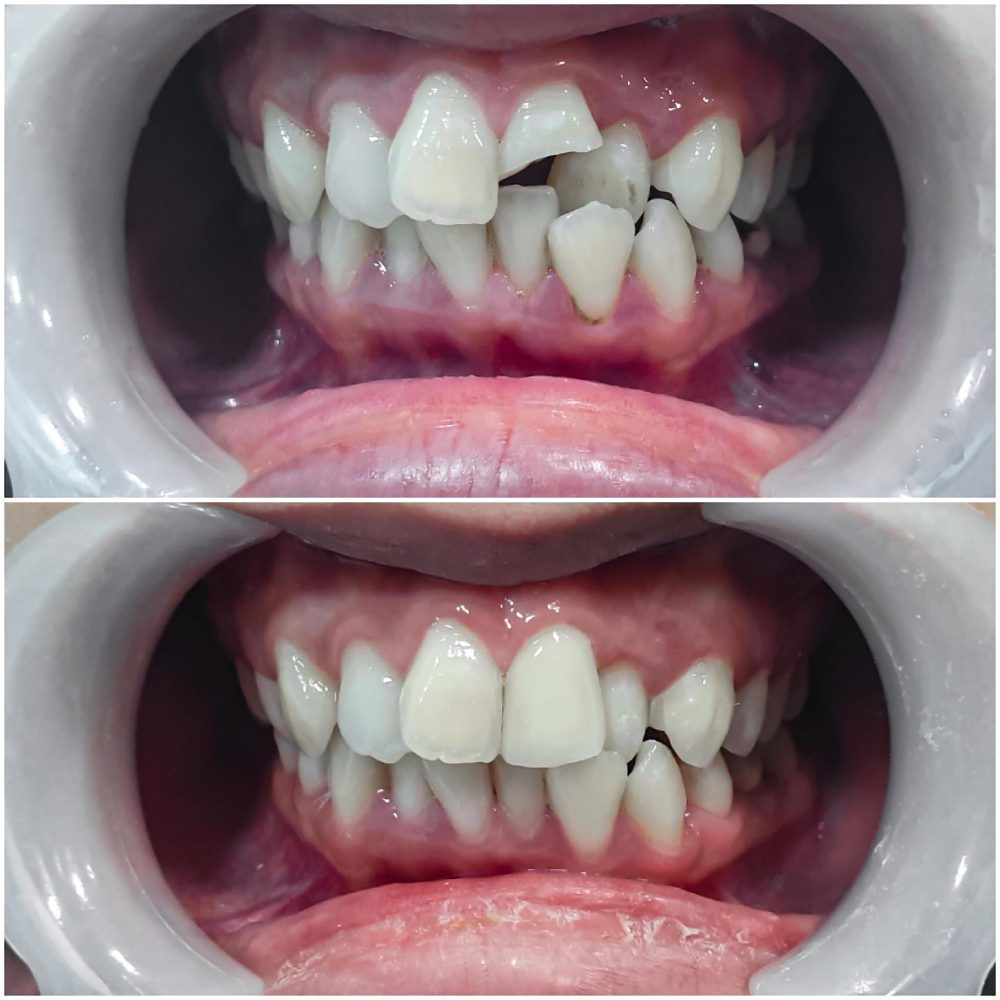
According to the AAE, chipped teeth are among the most common dental injuries. Many can be repaired by reattaching the broken fragment, using tooth-colored composite bonding, or placing a dental crown.
Cleveland Clinic notes that cracks frequently affect upper front teeth and lower back molars. Fractures of front teeth caused by accidents or injuries require particular attention because both function and appearance are involved.
For more information about restoring the appearance of damaged front teeth, read Cosmetic Restoration of Broken Front Teeth.
What Causes Teeth to Crack or Break?
The most common causes of broken teeth include biting hard foods, large fillings that weaken tooth structure, teeth grinding and clenching, injuries and accidents, and age-related wear.
- Age: Cleveland Clinic notes that people aged 50 and older are more likely to develop cracked teeth.
- Hard foods: Ice, hard candy, unpopped popcorn kernels, bones, and hard bread can cause fractures.
- Previous dental work: Large fillings and root canal-treated teeth, especially when they have not received an appropriate protective restoration, may be more vulnerable to fracture.
- Teeth grinding and clenching: These habits, often associated with stress, expose teeth to repeated forces.
- Trauma: Falls, sports injuries, and road accidents.
- Harmful habits: Nail biting or using teeth to open packaging or bottles.
What Are the Symptoms of a Broken or Cracked Tooth?
The most characteristic symptom of a broken or cracked tooth is sharp pain when biting or chewing, sometimes particularly when releasing pressure after biting. Other symptoms may include sensitivity to hot, cold, or sweet foods and pain that comes and goes, making it difficult to identify the affected tooth.
The AAE explains that a cracked tooth may eventually begin to hurt spontaneously, even without an obvious trigger. A vertical root fracture, meanwhile, may remain unnoticed until infection or inflammation develops around the root.
Warning Signs That a Fracture Has Affected the Dental Pulp or Caused Infection
According to Cleveland Clinic, an untreated crack can result in an infection or dental abscess. Possible warning signs include:
- Persistent tooth pain that does not subside.
- Swelling around the affected tooth or in the face.
- Unpleasant breath or odor.
- Fever or swollen lymph nodes.
If the tooth becomes increasingly sensitive to temperature or develops persistent pain, a dental examination is necessary to determine whether the pulp has been affected.
What Should You Do Immediately After Breaking a Tooth? Step-by-Step First Aid
If you break a tooth, rinse your mouth with warm water, control bleeding by applying pressure with clean gauze, place a cold compress against your cheek, preserve any broken fragment in milk or saliva, and contact a dentist as soon as possible.
The American Dental Association (ADA), through MouthHealthy, recommends rinsing the mouth with warm water. MedlinePlus advises applying pressure with clean gauze to help stop bleeding.
The UK National Health Service (NHS) recommends placing the broken fragment in milk or saliva collected in a small container and bringing it to your dentist. In some cases, the dentist may be able to reattach it. Avoid allowing the fragment to dry out or cleaning it with alcohol or hydrogen peroxide.
Cleveland Clinic explains that a cold compress against the face, rinsing with salt water, and suitable pain-relieving medication may temporarily reduce discomfort. If breathing through the mouth or drinking cold liquids causes pain, the AAE suggests gently biting on clean, moist gauze.
The AAE advises against placing aspirin tablets, topical painkillers, or ointments directly on the tooth or gums. Avoid chewing on the affected side and stay away from hard foods and extremely hot or cold drinks.
Cleveland Clinic emphasizes that a broken tooth cannot be repaired at home. MedlinePlus notes that a small, painless chip may not require emergency treatment, but its sharp edges should still be evaluated and repaired to prevent injury to the tongue or soft tissues.
When Is a Broken Tooth a Dental Emergency?
According to the NHS, a chipped or broken tooth is not always a serious emergency. However, Cleveland Clinic notes that severe fractures may require urgent treatment.
Seek urgent dental or medical care if you experience:
- Inability to bring your upper and lower teeth together normally, which may indicate a jaw fracture.
- Heavy bleeding that does not stop with pressure.
- Rapidly spreading facial swelling or a high fever.
- Severe, persistent pain or visible red or pink tissue inside the broken tooth, suggesting pulp exposure.
- A tooth that has been completely knocked out of its socket.
A completely knocked-out permanent tooth requires immediate emergency dental care and should be handled differently from a broken fragment.
How Does a Dentist Diagnose a Cracked or Broken Tooth?
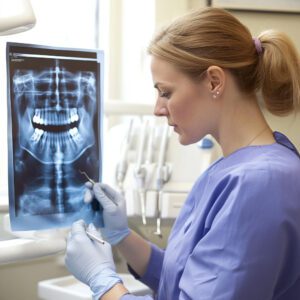
Dentists diagnose tooth fractures using a clinical examination, bite tests, transillumination or special dyes to reveal cracks, dental X-rays, and sometimes three-dimensional cone-beam computed tomography (CBCT).
The dentist may also measure periodontal pocket depths around the affected tooth to determine whether a crack extends below the gumline.
In complex cases, a referral to an endodontist may be necessary. Fine cracks may not appear on conventional dental X-rays, so diagnosis often depends on combining several clinical findings and imaging techniques.
Modern digital diagnostic tools can support the dentist in assessing radiographs, roots, and the condition of the dental pulp.
When Can a Broken Tooth Be Saved, and What Are the Treatment Options?
A broken tooth can often be preserved when the fracture is limited to the crown—the visible part of the tooth—and does not extend deeply below the gumline or into the root.
Treatment may involve composite bonding, a dental crown, or root canal therapy followed by a crown, depending on the depth of the fracture and whether the pulp is affected.
| Type of Tooth Fracture | Usual Treatment | Can the Tooth Be Saved? |
|---|---|---|
| Craze lines | Usually no treatment; cosmetic polishing may sometimes be considered. | Yes. They generally do not compromise the tooth. |
| Small chipped edge | Smoothing, composite bonding, or reattachment of the broken fragment. | Usually yes. |
| Fractured cusp | New filling or dental crown. | Usually yes; the pulp is rarely affected. |
| Cracked tooth not extending below the gumline | Dental crown, with root canal treatment if the pulp is damaged. | Often yes, especially when diagnosed early. |
| Cracked tooth extending beneath the gumline | Extraction and tooth replacement. | Usually not, according to the AAE. |
| Split tooth | Extraction, or occasionally preservation of one segment following specialized treatment. | The entire tooth cannot generally be saved. |
| Vertical root fracture | Usually extraction; selected cases may be considered for specialized root surgery. | Rarely. |
1. Composite Bonding and Reattachment of the Broken Fragment
For small fractures, the dentist can rebuild the missing portion using tooth-colored composite resin. The material is shaped and polished to restore the tooth's appearance and function.
The NHS also notes that, when the broken fragment is available and properly preserved, it may sometimes be reattached to the original tooth.
For more details about this conservative treatment, read Bonding for Broken Tooth Treatment in Turkey.
If the fracture involves a visible front tooth, aesthetic restoration can be particularly important. Our related guide explains cosmetic restoration options for broken front teeth.
2. Dental Crowns
When a fracture is larger or a back tooth has a significant crack, a dental crown may be recommended. The crown covers the tooth and helps distribute chewing forces, reducing the risk of further fracture progression.
According to the AAE, a crown offers substantial protection for cracked teeth, although it cannot guarantee that the crack will never progress.
3. Root Canal Treatment Followed by a Crown
If the fracture reaches the dental pulp or causes irreversible pulp inflammation, root canal treatment may be needed, followed by a protective crown.
The NHS notes that root canal treatment can be necessary when a tooth is severely damaged and its nerves are exposed.
What Are the Long-Term Success Rates of Cracked Tooth Treatment?
Research suggests that many treated cracked teeth remain functional for years, particularly when the pulp is still vital. Full-coverage crowns are also important for the long-term survival of many root canal-treated cracked teeth.
However, cracks can continue to progress even after treatment.
A 2024 systematic review and meta-analysis published in the Journal of Dentistry by Zhang and colleagues examined the outcomes of cracked tooth treatment and reported the following findings:
| Condition | Tooth Survival Rate | Follow-Up Period |
|---|---|---|
| Cracked tooth with a vital pulp | 97.8% to 92.8% | 1 to 6 years |
| Cracked tooth after root canal treatment | 91.1% to 83.0% | 1 to 4 years |
| Root canal-treated cracked tooth without a full-coverage crown | Approximately 11.3 times higher risk of extraction compared with teeth protected by a crown. | |
In practical terms, these findings highlight the importance of diagnosing cracks before they extend into the pulp or root.
They also suggest that postponing a recommended crown after root canal treatment may expose a cracked tooth to additional fracture risk.
These percentages represent findings from studies with different methodologies and levels of evidence. They should not be interpreted as guaranteed results for an individual patient.
When Does a Broken Tooth Need Extraction and Dental Implants?
Extraction may become necessary when a fracture extends deeply below the gumline or into the root, when the tooth splits into segments that cannot be predictably restored, or when an extensive vertical root fracture is present.
After extraction, dental implants and dental bridges are among the available tooth replacement options.
The AAE explains that a cracked tooth extending beneath the gumline may no longer be salvageable and that extraction is common for vertical root fractures.
Cleveland Clinic also notes that extraction may be needed when severe damage affects the root or dental pulp and the tooth cannot be restored.
Why Are Dental Implants a Common Option After Extracting a Broken Tooth?
Mayo Clinic explains that a dental implant replaces the missing tooth root and integrates with the jawbone. It provides a stable foundation for an artificial tooth and does not rely on the adjacent teeth for support in the same way as a conventional dental bridge.
To explore available restorative options, visit Dental Treatment in Turkey.
Can a Dental Implant Be Placed Immediately After Extraction?
In selected cases, an implant can be placed during the same appointment as the tooth extraction. This approach is known as immediate implant placement.
It may be possible when the remaining bone provides adequate support and the clinical conditions are suitable. Active infection, bone loss, or extensive damage may complicate the decision, although infection is not an absolute contraindication in every case.
When appropriate, the dentist may recommend allowing the extraction site to heal or performing bone grafting before implant placement.
If a fractured tooth is located in the upper posterior jaw, a sinus lift may sometimes be necessary when there is insufficient bone height for an implant.
| Comparison | Saving the Tooth: Crown / Root Canal | Extraction Followed by Implant |
|---|---|---|
| When is it appropriate? | Fracture limited to the crown or crack that does not extend beneath the gumline. | Deep subgingival crack, split tooth, or vertical root fracture that cannot be restored. |
| Preserves the natural tooth? | Yes. | No. The missing tooth is replaced with an implant-supported restoration. |
| Expected treatment duration | One or more appointments over days or weeks, depending on the procedure. | Often several months to allow bone integration, according to Mayo Clinic. |
How Is a Dental Implant Placed After a Broken Tooth Is Extracted?
Dental implant treatment after extracting a fractured tooth generally involves several stages:
The damaged tooth is removed, the jawbone is assessed and grafted if necessary, the implant is placed, and a healing period allows the implant to integrate with the surrounding bone.
Once the implant is sufficiently stable and healed, an abutment and final crown are fitted.
The entire process commonly takes several months, although the timing varies depending on the condition of the bone, whether grafting is required, and the selected treatment protocol.
Mayo Clinic notes that osseointegration—the process of jawbone growing around the implant—can take several months. The gums may also require a healing period after abutment placement before the final restoration is fitted.
Digital treatment planning helps dentists evaluate the available bone and plan the implant's position.
How Can You Prevent Tooth Fractures?
Not every tooth fracture can be prevented, but several habits can significantly reduce the risk.
- Avoid chewing ice, hard candy, unpopped popcorn kernels, and pens, as recommended by the AAE and Cleveland Clinic.
- If you clench or grind your teeth during sleep, ask your dentist about a custom night guard.
- Wear a protective mouthguard during contact sports and always use a seat belt when traveling by car.
- Maintain good oral hygiene and attend regular dental examinations so weakened fillings and early damage can be identified.
- Do not postpone a crown if your dentist recommends one to protect a vulnerable root canal-treated tooth.
Broken Tooth Treatment and Dental Implants in Istanbul
At Dental Implants in Turkey in Istanbul, assessing a broken tooth begins with a clinical examination and appropriate dental imaging.
We then explain the findings clearly: Can the tooth be saved with composite bonding, a crown, or root canal treatment? Or has the fracture extended into the root so that extraction and tooth replacement may offer a more predictable outcome?
When dental implants are considered appropriate, we explain the proposed procedure, expected number of visits, and estimated length of stay in Istanbul for patients traveling from abroad.
Follow-up arrangements and individual healing requirements are also discussed. The final treatment plan depends on the clinical examination, and outcomes vary between patients.
For an overview of available services, see Dental Treatment in Turkey.
Key Takeaways
- Tooth fractures include craze lines, fractured cusps, cracked teeth, split teeth, and vertical root fractures.
- A crack in a tooth does not heal naturally and may progress over time, making early diagnosis important.
- First aid includes rinsing with warm water, applying a cold compress, preserving broken fragments in milk or saliva, and arranging dental care.
- Many fractures limited to the crown can be treated with bonding, a crown, or root canal treatment followed by a crown.
- Cracks extending below the gumline, split teeth, and vertical root fractures may require extraction followed by a dental implant or bridge.
Related Articles
Bonding for Broken Tooth Treatment in Turkey Cosmetic Restoration of Broken Front Teeth Dental Treatment in Turkey: Available Procedures and Options Dental Implants in Turkey: Our Clinic and ServicesHave You Broken a Tooth and Want to Know Whether It Can Be Saved?
Send us a clear photograph of the damaged tooth or any available dental X-rays, along with a brief description of what happened.
The team at Dental Implants in Turkey in Istanbul can explain the possible treatment options and the next steps needed for a proper evaluation.
Contact Us on WhatsApp: +90 534 445 94 44 Visit Our WebsiteFrequently Asked Questions About Broken Teeth
Can a broken tooth heal on its own?
No. The American Association of Endodontists explains that a cracked tooth does not heal like a broken bone. A crack may continue to progress, so professional evaluation is important even if the pain decreases.
Is a broken front tooth a dental emergency?
Not always. A small, painless chip may not require emergency treatment. However, severe pain, exposed pulp, bleeding, or difficulty closing the jaws normally requires urgent attention. Preserve any broken fragment in milk or saliva.
How can I tell whether my molar is cracked or decayed?
A cracked molar often causes sharp pain when biting or releasing pressure. The pain may come and go, and fine cracks may not appear on ordinary X-rays. Dentists use bite tests, transillumination, dyes, and imaging to distinguish between cracks and tooth decay.
Can a broken tooth be repaired with dental bonding alone?
Yes, small chips and broken edges can often be repaired using tooth-colored composite bonding. In some cases, the original broken fragment can be reattached. Larger fractures and cracks in molars often require a dental crown.
Does every broken tooth need root canal treatment?
No. Root canal treatment is generally necessary only when a fracture damages the pulp, causes irreversible inflammation, or leads to infection. The tooth may then require a crown for protection.
When does a broken tooth need to be extracted?
Extraction may be required when a crack extends deeply beneath the gumline or into the root, when the tooth splits into separate parts, or when an extensive vertical root fracture cannot be treated. A dentist determines this through clinical examination and imaging.
Can a dental implant replace a broken tooth on the same day as extraction?
In selected cases, yes. Immediate implant placement may be appropriate when sufficient healthy bone remains and the clinical conditions are favorable. Other cases may require healing time or bone grafting before implant placement.
What should I do if my tooth breaks at night and no dentist is available?
Rinse with warm water, apply a cold compress to your cheek, use an appropriate pain reliever if safe for you, preserve broken fragments in milk or saliva, and avoid chewing on the affected side. Arrange dental care as soon as possible. Seek emergency help for severe bleeding, major facial injury, or rapidly spreading swelling.
How long can a cracked tooth last after receiving a crown?
The American Association of Endodontists notes that many treated cracked teeth remain functional for years. However, a crown does not guarantee long-term success, and a crack may progress even after treatment.
Conclusion: A Broken Tooth Does Not Always Mean Tooth Loss
A broken tooth is a common dental problem that can range from harmless surface enamel lines to severe root fractures requiring extraction.
In many cases, early diagnosis makes it possible to save the tooth using composite bonding, a crown, or root canal treatment.
When the natural tooth cannot be preserved, dental implants may provide an effective replacement option after a careful assessment.
Do not wait until the pain becomes severe. The earlier a crack is examined, the greater the opportunity to evaluate all available treatment options.
If you would like an assessment, the team at Dental Implants in Turkey in Istanbul welcomes your questions and can review the photographs or dental X-rays you share through WhatsApp.
Scientific References
- American Association of Endodontists (AAE). Cracked Teeth. aae.org
- Cleveland Clinic. Cracked Tooth / Fractured Tooth: Symptoms, Causes & Treatment. my.clevelandclinic.org
- NHS. Chipped, Broken or Cracked Tooth. nhs.uk
- MedlinePlus (U.S. National Library of Medicine). Broken or Knocked Out Tooth. medlineplus.gov
- American Dental Association – MouthHealthy. Dental Emergencies. mouthhealthy.org
- Zhang S, Xu Y, Ma Y, et al. The Treatment Outcomes of Cracked Teeth: A Systematic Review and Meta-Analysis. Journal of Dentistry, 2024. pubmed.ncbi.nlm.nih.gov
- Mayo Clinic. Dental Implant Surgery. mayoclinic.org